The Rui Chinese name meaning cannot be determined from the letters R-u-i alone. In Mandarin, 瑞 (ruì) can suggest auspiciousness, 睿 (ruì) means wise or discerning, 锐/銳 (ruì) can mean sharp or perceptive, and 芮 (ruì) has its own botanical and surname history. A similar-looking pinyin form, 蕊 (ruǐ), uses the third tone and refers to the reproductive part of a flower or a flower bud.
The practical rule is simple: ask for the Chinese character and tone before interpreting the name. A romanized spelling is a pronunciation guide, not a complete definition.

Quick answer: what does Rui mean in Chinese?
If someone writes only Rui, there is no single reliable translation. These are five useful possibilities to check first:
| Character | Pinyin | Dictionary meaning relevant to a name | Interpretation boundary |
|---|---|---|---|
| 瑞 | ruì | an auspicious sign; auspicious | Supports an association with good omens, but does not promise luck or success. |
| 睿 | ruì | wise, intelligent, or discerning | Expresses an aspiration or admired quality, not a prediction of personality. |
| 锐 / 銳 | ruì | sharp, strong, perceptive, or acute | The exact impression depends on the second character and the full name. |
| 芮 | ruì | tender new plant growth; also a surname | Do not automatically translate it as “lucky” or “wise.” |
| 蕊 | ruǐ | the reproductive part of a flower; a flower bud or flower | This is third tone, not the fourth tone used by the four characters above. |
These are dictionary meanings, not complete judgments about whether a character is suitable for a particular child or family. Naming also involves sound, surname pairing, regional pronunciation, writing form, and family associations.
瑞 (ruì): auspicious signs and good wishes
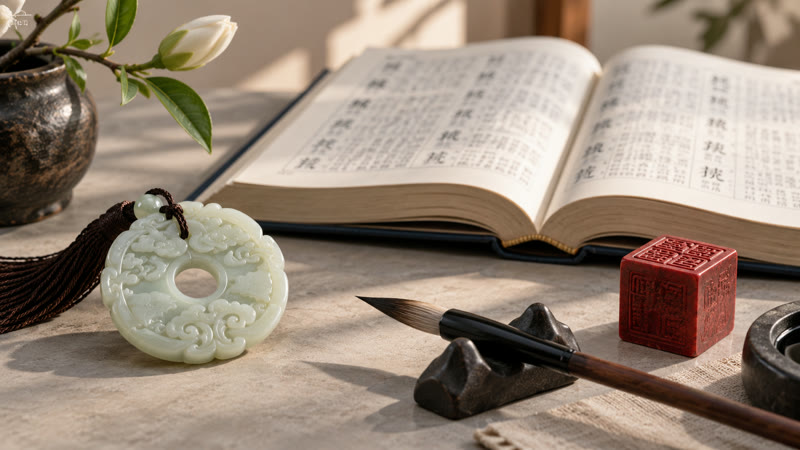
The Taiwan Ministry of Education’s dictionary entry for 瑞 gives two connected senses. Historically, it could refer to a jade token used as a sign of authority or trust. It also means an auspicious sign and can function as an adjective meaning auspicious.
That makes 瑞 a natural option when a family wants the name to carry a hopeful association with favorable signs or blessings. The careful English gloss is “auspicious” rather than a guarantee such as “will be lucky.” Chinese name meanings usually express intention, value, or hope; they do not establish a future outcome. For a broader character comparison, see our guide to Chinese names related to luck.
睿 (ruì): wisdom and discernment
The character 睿 is also pronounced ruì in Mandarin. The official dictionary entry for 睿 defines it as wise or intelligent and also describes the ability to understand matters clearly.
In a name, 睿 can therefore communicate an aspiration toward wisdom, sound judgment, or insight. It should not be translated as proof that the person possesses those traits. The name carries a semantic association; personality remains individual.
锐 or 銳 (ruì): sharpness, strength, and perception
锐 is the simplified form and 銳 is the traditional form. The dictionary entry for 銳 includes senses such as sharp, strong, and perceptive. In everyday English, a phrase such as “a sharp mind” captures part of the positive naming association better than the literal image of a sharp object.
This character can feel energetic and direct, but its effect changes when combined with another character. Before choosing it, read the full name aloud with the surname and ask a fluent speaker whether the combination creates an unintended phrase or awkward rhythm.
芮 (ruì): tender growth and a surname history
The character 芮 is another fourth-tone ruì. The dictionary entry for 芮 describes tender new grass or plant growth. It also records 芮 as a surname.
This is a good example of why a one-word translation can mislead. A family may choose 芮 for its sound, shape, lineage, or a personal association, not because they intend a literal botanical description. If 芮 appears at the beginning of a two-character or three-character name, first confirm whether it functions as the family surname or as part of the given name. Our Chinese last-name meanings guide explains why surname position and documented origin matter.
蕊 is pronounced ruǐ with the third tone. The official dictionary entry for 蕊 identifies it as the reproductive part of a plant and also records the sense of a flower bud or flower.
Without tone marks, both ruì and ruǐ may appear online as Rui. That spelling collision is one reason not to identify a Chinese name by sound alone. Ask the writer to provide the character, then record the tone-marked pinyin beside it.
Is Rui a boy’s name or a girl’s name?
The romanized syllable Rui does not determine gender. A character may appear in names used by people of different genders, while the complete name may sound more traditionally masculine, feminine, or neutral to different families and communities.
Instead of assigning a gender label to the syllable, evaluate the exact character combination. The surname, second given-name character, generation name, family tradition, and regional usage all affect how the result is perceived.
Rui name verification factors
Use this sequence rather than starting with an English baby-name list:
- Get the exact characters. Ask whether the intended name is 瑞, 睿, 锐/銳, 芮, 蕊, or another character.
- Record tone-marked pinyin. Write ruì or ruǐ, not only Rui. The tone distinguishes otherwise identical roman letters.
- Confirm simplified or traditional form. For example, 锐 and 銳 are different written forms of the same character. Use the form appropriate to the family’s literacy and document context.
- Read the complete name with the surname. Check rhythm, repeated sounds, and accidental phrases. A character that works alone may feel different in the full name.
- Ask about family and regional context. Mandarin pinyin does not capture every regional or heritage-language pronunciation. A Cantonese-speaking or other Chinese-language family may use a different spoken form or romanization.
- Request a fluent human review. A dictionary can verify a base meaning, but a fluent speaker can notice social tone, literary associations, and awkward combinations.

A safe way to explain a Rui name in English
Use a three-part explanation:
The name uses [character], pronounced [tone-marked pinyin] in Mandarin. Its dictionary meaning includes [supported meaning]. In this family, it was chosen to express [family’s stated intention].
For example, a family using 瑞 (ruì) might say that the character is associated with auspicious signs and was chosen as a hopeful family wish. That is more accurate than saying, “Rui means the child will be lucky.”
Likewise, a family using 睿 (ruì) can describe its association with wisdom without claiming that the name determines intelligence. This wording respects both the language evidence and the family’s personal reason for choosing the name.
Limits of the romanized spelling Rui
- – Treating pinyin as the meaning. Pinyin represents pronunciation; the character carries the lexical meaning.
- – Dropping the tone. Ruì and ruǐ are not interchangeable pronunciations.
- – Assuming every Rui means lucky. That association fits 瑞, not every character romanized as Rui.
- – Ignoring the surname. 芮 can be a surname, so its position and family context matter.
- – Using a trait as a promise. 睿 and 锐/銳 can express admired qualities, but a name does not guarantee intelligence, strength, or achievement.
- – Choosing from appearance alone. Similar pronunciation does not make the characters culturally or semantically equivalent.
Frequently asked questions
Does Rui mean lucky in Chinese?
Sometimes. 瑞 (ruì) is associated with auspicious signs, so “auspicious” is a supported gloss. Other Rui characters have different meanings, so the spelling alone does not mean lucky.
Does Rui mean wise?
It can when the character is 睿 (ruì), which is associated with wisdom and discernment. Confirm the written character before using that translation.
Is Rui always pronounced with the fourth tone?
No. 瑞, 睿, 锐/銳, and 芮 are pronounced ruì in the cited dictionary entries, while 蕊 is ruǐ with the third tone.
Is Rui a Chinese surname?
芮 (ruì) is recorded as a surname. Rui can also represent a character in a given name, so name order and the original Chinese writing matter.
Which Rui character is best for a baby name?
There is no universally best character. Choose only after checking the desired meaning, tone, surname pairing, written form, family tradition, and a fluent speaker’s reaction to the complete name.
Final takeaway
The most accurate answer to “What does Rui mean in Chinese?” begins with another question: Which character and which tone? 瑞, 睿, 锐/銳, 芮, and 蕊 share a similar romanized appearance but do not share one definition. Verify the written character, use tone-marked pinyin, and interpret the full name in family and language context.